

Someone in Lenny’s Community recently asked how to teach storytelling to their product team.
The question hit close to home, because in my work, I see that most product and engineering teams in SaaS feel the importance of story — they know it’s an important skill — but can’t explain what it really is.
tldr: Every great product has a story arc. Story in the product world is the structured movement from tension to transformation. It’s a formula. (P.S. The story is actually about the customer.)
Here’s what I shared and how to try it.
Think about your favorite book or movie. Typically, story follows a simple arc:
The world before (tension)
What does a normal day look like for your user before your product exists? What tradeoffs are they making? What are their struggles?
When things change (turning point)
What triggers the realization that “this can’t go on”?
The new world (transformation)
How does their day look different now?
That’s the (simplified) story spine. Everything else — roadmaps, OKRs, decks — flows from it.
Our colleagues in Sales have known this forever. They sell the before and after. For product builders, the story is told inward to the team, and outward again to users.
When your team can tell the story forward and backward, you’ve struck gold.
Forward: What transformation do we deliver for our customer?
Backward: What truth about the user or problem made this product necessary?
Why it matters
It helps teams say no to features that don’t serve the transformation and make better decisions. It builds alignment across disciplines because every team can picture the same “before” and “after.” They know what kind of world they’re trying to build and for whom.
Story acts as a strategic backbone. It’s a living artifact that connects purpose (why we exist), product (what we build), and proof (how we know it’s working). When the story is clear, prioritization gets easier, communication gets sharper, and belief starts to spread.
Try it: A fast path is to try it with a single customer story that you know well, and then extrapolate that to a broader product story (which really is a customer story):
Before, ACME Corp felt _______ and struggled with _______
The turning point was _______
And now? ACME Corp _______
Your narrative becomes the throughline for how you describe, prioritize, and measure work. It’s alignment — at least at the story, context, or “why” level that makes the next level of alignment (the what/when) much easier.
A clear story clarifies strategy; a clear strategy strengthens the story. That turns into velocity.
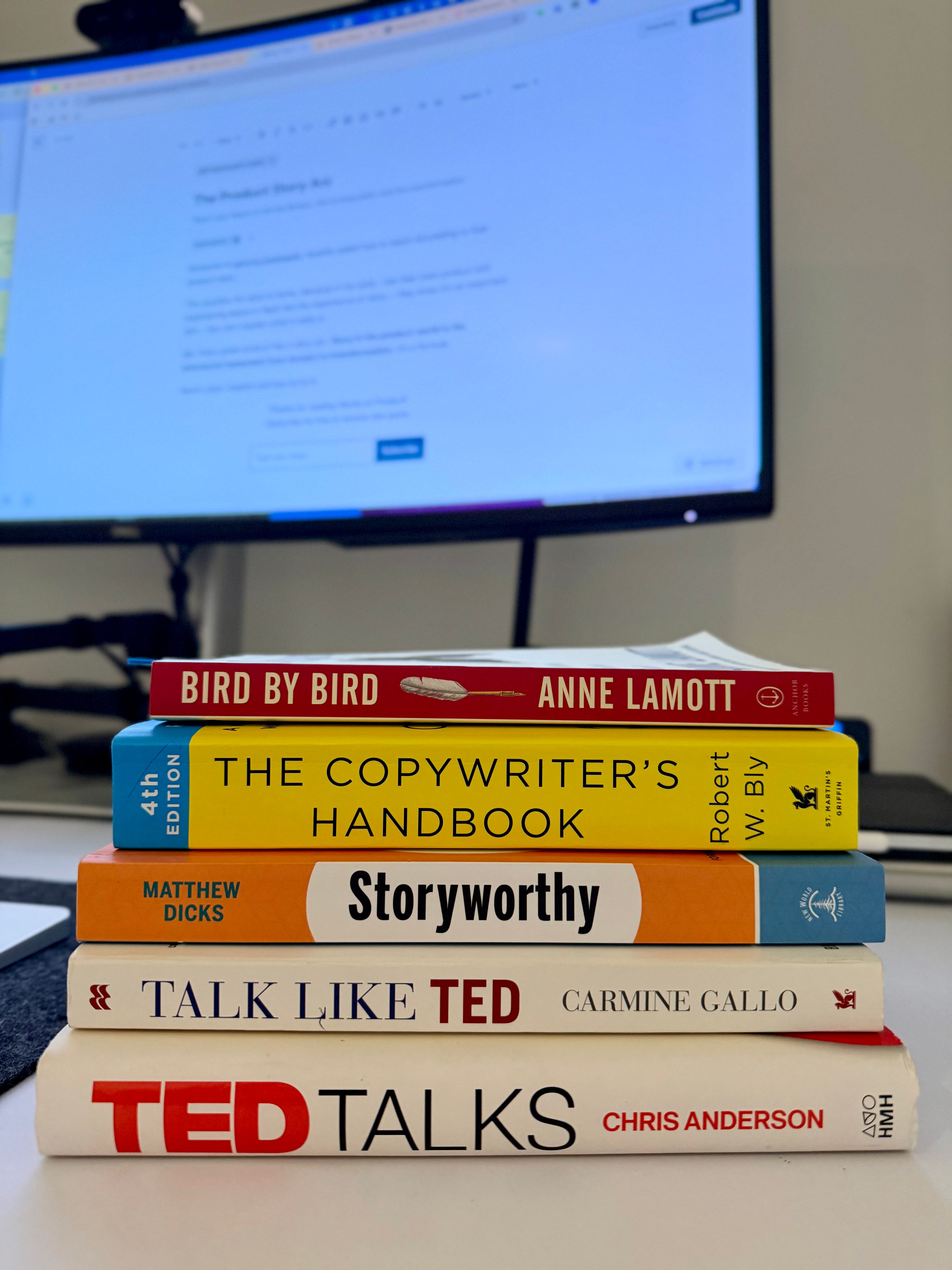
There are loads of books on storytelling, but here are a few on my bookshelf.
Bottom line: Every great product has a story arc that centers on the customer. When teams can name the tension, see the turning point, and describe the transformation, strategy starts showing up in decisions.